Why Dressing Less Is Actually a Power Move
There's a particular kind of person you've probably noticed. They show up to every meeting, every panel, every red carpet moment in a version of the same outfit. Same silhouette. Same palette. Maybe even the same exact shirt. And somehow — somehow — they look sharper, more intentional, and more themselves than anyone else in the room.
This isn't an accident. It's a system. And once you understand it, you might never shop the same way again.
The Paradox of Too Many Options
Let's start with the psychology, because this is where it gets interesting. Researchers have been studying decision fatigue for decades, and the findings are pretty consistent: the more choices you make throughout a day, the worse your decision-making gets over time. Your brain treats picking an outfit the same way it treats any other decision — it uses real cognitive resources to do it.
For people who are already managing a lot — running companies, leading creative teams, building something from scratch — every choice that doesn't directly serve their goals is a quiet tax on their bandwidth. Stripping away wardrobe decisions isn't minimalism for minimalism's sake. It's resource management.
But here's the part that often gets left out of that conversation: it's not just about saving mental energy. It's about what you do with the energy you reclaim.
The Signature Look as a Personal Brand Tool
Think about some of the most recognizable figures in American culture over the past couple of decades. The tech founder in the black turtleneck. The creative director who lives in head-to-toe neutrals. The CEO who's never photographed without her signature oversized blazer. These aren't people who ran out of ideas. These are people who made a deliberate choice to become visually consistent.
Visual consistency is a form of branding, and personal branding is just storytelling. When you wear a signature look, you're telling people something about your priorities, your taste, and your sense of self — without saying a word. You become easier to remember, easier to recognize, and paradoxically, more interesting. Because a person who commits to a look reads as confident in a way that someone cycling through every trend simply doesn't.
This matters beyond the boardroom, too. Whether you're a freelancer trying to build a client base, a creative professional showing up to pitches, or just someone who wants to feel more anchored in how they present themselves — a consistent visual identity does real work for you.
Constraints as Creative Fuel
Here's the counterintuitive part: limiting your wardrobe doesn't dull your style. It actually sharpens it.
When you're not chasing every new drop or trying to make a dozen different aesthetics coexist in one closet, you get really good at the thing you do wear. You start to understand proportion, fabric quality, and fit in a way that someone with a packed, chaotic wardrobe rarely does. You invest more thoughtfully. You notice details. You develop an eye.
This is something professional stylists understand intuitively. Working within constraints — a specific color palette, a defined silhouette, a handful of go-to pieces — forces a kind of creative problem-solving that an unlimited budget and unlimited options never will. The uniform effect isn't a creative limitation. It's a creative framework.
What a Wardrobe Uniform Actually Looks Like
Let's get practical, because this isn't about wearing the literal same outfit every single day (unless you want to — genuinely no judgment). It's about identifying your version of a signature system.
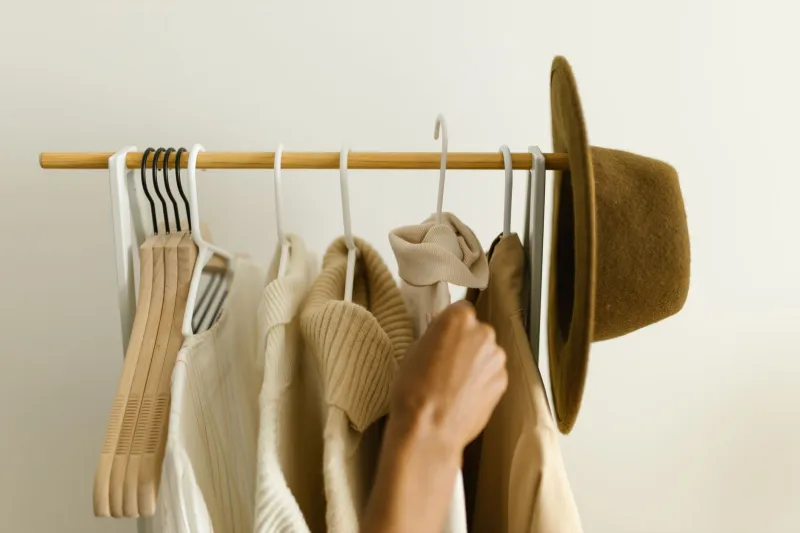
For some people, that looks like a color palette: three or four shades that always work together, so every piece you own can theoretically pair with everything else. For others, it's a silhouette — maybe you always feel best in wide-leg pants and a tucked-in top, or you're a blazer-over-everything person who's finally leaning into it. For others still, it's a texture or fabric story — linen in summer, wool in winter, always clean and unfussy.
The key is that your system should feel like you, not like a trend you read about. The most effective wardrobe uniforms aren't borrowed aesthetics. They're the result of paying attention to what you actually reach for, what makes you feel capable and clear-headed, and what consistently earns you compliments without you trying.
How to Find Your Own Version
Start by looking at what you already wear on autopilot. Not what you think you should wear or what you bought with good intentions — what you actually put on when you're running late and don't have time to overthink it. Those are the pieces your gut has already voted for.
From there, ask yourself a few questions:
- What's the common thread? Is it a color? A fit? A level of formality?
- What do you feel most like yourself in? Not most fashionable, not most put-together — most you.
- What would you wear every day if no one was judging? That answer is almost always more stylish than people expect.
Once you've got a rough outline of your personal uniform, the goal isn't to stop evolving — it's to stop chasing. You can still try new things, incorporate seasonal pieces, and have fun with fashion. But you do it from a stable foundation, not from a place of wardrobe anxiety.
The Confidence That Comes From Commitment
There's something that happens when you stop second-guessing your look every morning. You walk differently. You take up space differently. You stop pulling at your clothes or wondering if you made the wrong call. That shift is subtle but it compounds over time, and other people feel it even if they can't name it.
The most stylish people aren't always the ones wearing the most interesting outfits. They're the ones who look like they made a decision and meant it. The uniform effect, at its core, is really just the confidence effect — and that's available to anyone willing to do the work of figuring out their own version of it.
Your style doesn't have to be complicated to be powerful. Sometimes the boldest move is the simplest one.